Archive

Posts Tagged ‘England’

Hungary vs England 1909

Classic Matches | 3 November 2009 | Paul Brown

It’s 100 years since Hungary became the first team from outside of the British Isles to compete in the UFWC. Here’s a flashback.

HUNGARY 2-4 ENGLAND, 29 May 1909
Friendly, Millenaris Sporttelep, Budapest
Scorers: Kesmarky, Grosz (Hungary); Woodward (2), Bridgett, Fleming (England)

In the UFWC’s 99th title match Hungary became the very first team from outside of the British home nations to take a bite at the UFWC.

For 37 years the title was passed exclusively between England, Ireland, Scotland, and Wales. England had already played European opposition outside of the UFWC, beating Hungary – and Austria and Bohemia – in the previous year. Now, having taken the title from Wales in March and successfully defended it against Scotland in April, England took the title into a short post-season continental tour.

Hungary were one of the oldest continental international football teams, having played their first international match against Austria in 1902. They were also one of the earliest members of the recently-formed FIFA. They had won more games than they had lost, but those games had been against fellow fledgling footballing nations, and Hungary were no real match for the experienced English.

Sunderland’s George Bridgett scored the first goal in front of 10,000 spectators after just five minutes. Vivian Woodward of Spurs and Harold Fleming of Swindon Town added to the score to give England a 3-1 half-time lead. Skipper Woodward netted a fourth in the second half to achieve the 4-2 victory.

Two days later the sides met for a rematch – and the landmark 100th UFWC title match. England named the same 11, and raced to a 5-0 half-time lead. The final score was 8-2, with Woodward hitting four, Fleming grabbing two, and George Holley of Sunderland also netting twice. The match marked the final international appearance of Evelyn Lintott, the Bradford City right half, who was killed in heroic circumstances at the Somme in 1916.

The day after beating Hungary 8-2, the same team – minus Lintott – beat Austria 8-1 in Vienna. But England would not play outside of the British Isles again until 1921, and the UFWC title continued to be passed between the British home nations.

Classic Matches ,

Ireland vs England 1919

80 years ago this month, international football resumed after the horrors of the Great War. We take a look back through the UFWC archives.

IRELAND 1-1 ENGLAND, 25 October 1919
British Home Championships, Windsor Park, Belfast
Scorers: Ferris (Ireland); Cock (England)

The first proper international match played after the Great War was this game between UFWC champions Ireland and challengers England. The war had put an end to international football fixtures for five and a half years, and stole the lives and careers of many of the era’s best footballers.

Lord Kitchener’s recruitment drive saw more than 500,000 men enlist by the end of September, but initially there were few footballers among them. However, after an appeal led by Sir Arthur Conan Doyle, and with more volunteers needed to replace the casualties lost in early battles, footballers began to sign up. ‘There was a time for games,’ said Conan Doyle, ‘but there is only time for one thing now, and that thing is war. If a footballer had strength of limb let them serve and march in the field of battle.’

At first, only amateurs were allowed to sign up but, under pressure to allow all footballers to fight for their country, the Football Association eventually called for professionals to be released by their clubs.

England centre-half Frank Buckley, who played in his country’s 1914 UFWC match against Ireland, was one of the first footballers to sign up, and he was charged with leading the 17th Service Battalion of the Middlesex Regiment, which became known as the Football Battalion. Almost a quarter of the battalion’s 600 men were footballers. Among them were former England captain and centre forward Vivian Woodward, and right-half Evelyn Lintott, both of whom played in the 1909 UFWC win over Hungary.

Woodward was one of the Football Battalion’s first casualties, being hit by a grenade and suffering a serious leg injury. Lintott was transferred to the West Yorkshire Regiment, and was killed leading his platoon ‘over the top’ at the Somme. Then Frank Buckley was hit in the chest by shrapnel, suffering lung damage. Comrades doubted their critically injured Major would make it to the casualty station, but he recovered, and returned to the front line six months later, only to suffer further lung damage in a poison gas attack. Another England player from the 1914 Ireland match, Edwin Latherton of Blackburn Rovers, was killed while serving with the Royal Field Artillery on the Western Front. Latherton had scored 94 goals in 258 games for Rovers.

Finally, at 11am on 11 November 1918, Armistice was declared. Many footballers had lost their lives or suffered career-ending injuries. Major Buckley estimated that 500 of the original 600 members of the Football Battalion had been killed.

A series of ‘Victory Internationals’ were played after Armistice was declared, but none of them stand in the record books as full internationals. These morale-boosting games offered a chance for football to rebuild itself after the sport had been dismantled by the war.

Ireland had played two Victory Internationals against Scotland, losing the first and drawing the second, but the UFWC title was not at stake. Although most friendly matches can count as a UFWC title matches, games in which National Associations do not field their first national representative team do not count. So the first full international did not take place until October 1919, as part of the first post-war football season.

Both Ireland and England fielded much-changed line-ups for this game, with only two players remaining in each side from their last pre-war UFWC matches. Michael Hamill and Bill Lacey remained for Ireland, and Sam Hardy and Bill Watson for England. While some stars had been killed or injured, others simply had their international careers cut short by the five and a half year war interruption. Ireland forward Frank Thompson and England captain Bob Crompton, who had won 41 caps, were among the pre-war stars who never played for their countries again.

New players had emerged, some having starred in the Victory Internationals, and the mood was one of excitement for a new beginning for international football. 30,000 spectators packed Windsor Park to see the two sides play out a 1-1 draw.

It was a decorated World War hero who opened the scoring – Jack Cock putting England ahead after just 30 seconds. Prolific striker Cock had just signed for Chelsea from Huddersfield Town, going on to score 47 goals in 99 appearances for the Blues.

Jimmy Ferris equalised for Ireland after 70 minutes. Ferris was with Belfast Celtic, but he signed for Chelsea in 1920, and played alongside Cock. His career was cut short by a heart condition, and he died in 1932 aged just 37.

Ireland retained the UFWC title, but soccer was the real winner. After a period of terrible darkness, international football was back.

Classic Matches ,

Netherlands 2-2 England

Match Reports | 12 August 2009 | Paul Brown

NETHERLANDS 2-2 ENGLAND, Amsterdam, 12/08/09
Kuyt 10, Van der Vaart 38, Defoe 49, 77

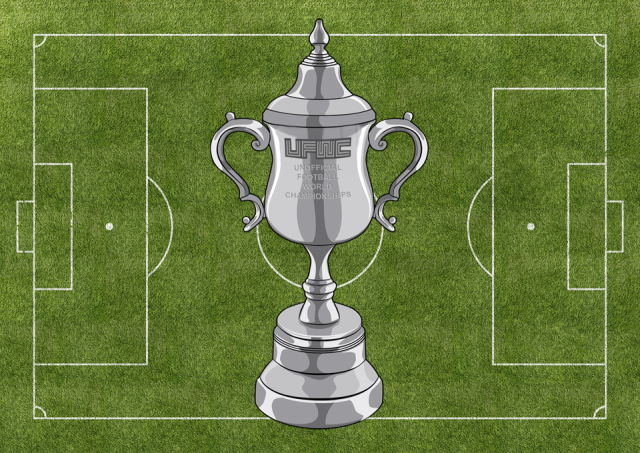
UFWC Trophy NetherlandsThe Netherlands retained the UFWC title in this entertaining game, but England didn’t make it easy. In what was very much a game of two halves, the Dutch threw away a two-goal lead, and were hanging on for much of the closing period.

England gifted the Netherlands the lead within 10 minutes, when Rio Ferdinand’s terrible backpass was picked up by Dirk Kuyt, who took the ball around Robert Green, checked back from a wide position, and drilled a shot past John Terry on the goalline.

And it was another England error that allowed the Dutch to double their advantage on 37 minutes, this time Gareth Barry’s poor backpass allowing Arjen Robben to test Green, with Rafael Van der Vaart netting the rebound.

A half-time hairdryer treatment from England boss Fabio Capello – and a triple substitution – paid almost immediate dividends. Frank Lampard’s hopeful punt was superbly controlled by sub Jermaine Defoe, who raced away to bury a left-foot shot in off the post.

Defoe pulled England level on 77 minutes, finishing from James Milner’s low pass.

Defoe and Carlton Cole both had chances to win the game for England, and Wesley Sneijder could have won it late on for the Dutch, but at the final whistle the scores were level, meaning the Netherlands retain the title, but don’t receive a ranking point.

The Netherlands’ next match is an interesting encounter with Japan in Enschede on 5 September. Should they retain the title, the next UFWC title match will be against all-time champions Scotland four days later.

The UFWC scorecast competion was won by Ansgar.

Match Reports ,

Netherlands vs England: ready for kick-off

Match Previews | 11 August 2009 | Paul Brown

Mascot England NetherlandsNETHERLANDS vs ENGLAND, Amsterdam, 12/08/09
Kick-off 19:45 BST, Live UK TV coverage on ITV1

Just 24 hours ahead of this huge UFWC title match, challengers England have been dealt a blow with the withdrawal from the squad of Steven Gerrard. The Liverpool midfielder is out with a slight groin strain (which will no doubt clear up by the time his club begin their Premier League campaign on Sunday…).

Also out for England is Manchester United keeper Ben Foster, injured in the Community Shield match at the weekend. With David James already out, Robert Green is likely to deputise in goal. Michael Carrick may step in for Gerrard.

England manager Fabio Capello decided against recalling Michael Owen to his squad, and also omitted Peter Crouch, so is likely to go with Wayne Rooney and Emile Heskey up front, with Theo Walcott providing support.

For UFWC champions the Netherlands, Giovanni van Bronckhorst and Mark van Bommel are already ruled out with injuries, while Eljero Elia and Stijn Schaars are both in Bert van Marwijk’s squad, but are considered doubtful.

The Dutch are likely to field an attacking line-up including Dirk Kuyt, Arjen Robben, Klaas-Jan Huntelaar and Robin Van Persie.

Fans of both nations will expect their side to have enough quality to win this game, and neutrals will be hoping that the two strong sides do not cancel each other – and the game – out.

Both teams have one hundred-percent records from their World Cup 2010 qualifying campaigns, with the Dutch already qualified, and England likely to join them should they win their next qualifier.

Both sides are ranked in the UFWC all-time top 5, and both are ranked in FIFA’s current top 10. The Netherlands are ranked fifth in the all-time UFWC rankings, with England second, behind all-time champions Scotland. The Netherlands are ranked third by FIFA, with England seventh.

The bookies make the Netherlands favourites. At the time of writing, best odds for a Dutch win are 7/5 at Boylesports. An English victory is 11/5 at Bet365. Coral have the draw at 23/10.

UFWC website visitors had also rated the Dutch as favourites, with 61 percent going for a Dutch win. Predict the correct score before kick off and win a UFWC book.

The match will be screened live in the UK on ITV1, with the broadcast beginning at 19:30, and the game kicking off at 19:45. [UPDATE: In the Netherlands, the match will be broadcast on SBS 6 - thanks Jesse.]

There will be a full match report here after the game.

See UFWC potted histories of the Netherlands and England, and get commemorative T-shirts.

Match Previews ,