Archive

Posts Tagged ‘Germany’

UFWC spin-offs update 2013

Features | 14 January 2013 |

Hughie the UFWC mascotAhead of the North Korea vs Sweden UFWC title match, we’re taking one of our regular looks at the main UFWC “spin-offs” – the unofficial continental titles, the wooden spoons, and the women’s titles – as tracked over at the UFWC forum.

Europe

Disappointingly, the unofficial European title didn’t find its way to Euro 2012 in Poland and Ukraine last summer. It was non-qualifiers Romania who held the title until August before losing a friendly in Slovenia. The Slovenians duly lost their opening World Cup qualifier to Switzerland, who have seen off challenges from Albania, Norway and Iceland to bring the title into 2013.

The woeful San Marino were European wooden spooners throughout 2012. Even a home match against Malta couldn’t save them (they lost 3-2). At home to Moldova, hardly world-beaters themselves, they managed just two shots to Moldova’s 11, with the visitors winning the corner count 7-0. Several more years as European wooden spooners look likely.

South America

Just one change of hands for the unofficial South American title in 2012. It came in September, when champions Uruguay were humbled 4-0 by a resurgent Colombia, who will hope their good form can continue through 2013, and earn them a first World Cup appearance since 1998.

2012 began with Bolivia as South American wooden spooners. They then beat Paraguay, the 2010 World Cup quarter-finalists and 2011 Copa America finalists, who had a terrible year. At least the Paraguayans managed to end the year free of the spoon, as they recorded a narrow 1-0 home win over current holders Peru.

Africa

There was huge controversy in the unofficial African championships in 2012, and it has yet to be settled conclusively. Things started well enough, with the Ivory Coast heading to the Cup of Nations as champions, then sailing through to the final, only to be upset by Zambia (on penalties). In June, Zambia lost a World Cup qualifier to Sudan. The title then passed to Libya, before ending the year with Algeria. Or did it? In October, FIFA announced that Sudan had fielded a player who was suspended, and overturned the result, awarding Zambia a default 3-0 win. However, FIFA’s results archive, which provides all results for the UFWC continental competitions, still records the match as a 2-0 win to Sudan. Attempts to contact FIFA on the matter have been unsuccessful! If we do indeed give the match to Zambia, the title then goes to Malawi, then Liberia, then Niger, then Ethiopia. As both potential holders are heading to the African Cup of Nations in January 2013, hopefully the two paths will merge soon.

Meanwhile, African wooden spooners Comoros did not even attempt to rid themselves of the burden during 2012. They didn’t play a match all year, and currently have no forthcoming fixtures arranged.

Asia

The 12 matches played by reigning UFWC champions North Korea during 2012 were all against Asian opposition, and so they still retain the unofficial Asian title as well as the world title.

Cambodia entered 2012 as wooden spooners, of both Asia and indeed the whole world. They played four matches, all in qualification for the AFF Suzuki Cup (a tournament for South-East Asian nations). Cambodia lost all four matches – to Timor-Leste, Laos, Brunei and hosts Myanmar. Every other nation won at least twice.

CONCACAF

Regional powerhouses Mexico held the title until August 2012, when the United States visited the Azteca. It was the Americans’ 22nd away match against Mexico, and they had lost every single one of the previous 21. Not this time, though. Mike Orozco scored the only goal of an extraordinary match. The USA promptly lost in Jamaica, but luckily for them, the return match occurred just four days later, and they were able to reclaim the title in double-quick time.

Anguilla played three times in 2012, but lost every time, and still hold the CONCACAF wooden spoon. The low point was a 10-0 defeat to Trinidad & Tobago.

Oceania

New Zealand, far and away the strongest team in the Oceania region, hadn’t had a look-in for the continental championship for some time. Surely they would win the 2012 OFC Cup, though? Amazingly, they lost to New Caledonia in the semi-final. It was Tahiti who went on to become official Oceanian champions, having already become unofficial champions earlier in the tournament with a win over New Caledonia. However, the advent of World Cup qualifying in September restored some order. Tahiti lost to the Solomon Islands, and four days later, New Zealand saw off the islanders to finally reclaim the title. They have since beaten Tahiti home and away.

No action for the Cook Islands this year; they retain the wooden spoon.

Women’s

Japan, who became official and unofficial women’s world champions in 2011, began 2012 with three wins in a row, but then lost 4-3 in Faro to Germany. The Germans have been fairly imperious since, and have already defended their title eight times. They missed out on competing in the London Olympics, though, due to their shock early exit in the 2011 World Cup, which they had themselves hosted.

Luxembourg began the year as women’s world wooden spooners. They only played twice in 2012, but, even though their opposition came in the less-than-intimidating shape of Malta and the Faroe Islands, and despite home advantage both times, they still lost twice.

You can get regular updates and discuss the UFWC spin-off competitions at the UFWC forum.

UFWC T-Shirt Shop

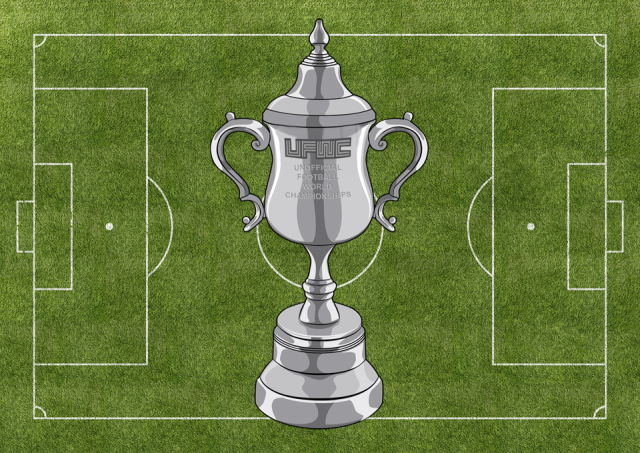
Get your UFWC T-shirts, including mascot, trophy and national teams, at our T-shirt shop

Features , , , , , ,

UFWC at the European Championship Final

UFWC News | 29 June 2012 |
Comments Off

The UFWC title will not be up for grabs during Sunday’s UEFA Euro 2012 final between Spain and Italy, with the current Unofficial Football World Champions being the very un-European North Korea. However, the title has been contested at four previous European Championship finals, including matches involving this year’s finalists.

The first occasion was in 1976, when UFWC champions Czechoslovakia met West Germany in Belgrade. This epic match was ultimately decided by one of the most famous penalty kicks of all time. Reigning European champions and World Cup holders West Germany lined up with the formidable Franz Beckenbauer at the heart of their side, but Czechoslovakia had a midfield legend of their own in Antonin Panenka.

The impressive Czechs took an early advantage, with Jan Svehlik and Karol Dobias putting them 2-0 up within half an hour. Dieter Muller pulled one back for West Germany, and, in the final minute, Bernd Holzenbein headed a last-gasp equaliser. The match went to extra-time, and then to penalties.

The first seven penalties were scored, but then Uli Hoeness blasted his kick over the crossbar. Up stepped Panenka. If the moustachioed midfielder scored, his country would win. He stepped to the ball, feigned to send the great Sepp Maier into a full-length dive, then coolly chipped the ball into the centre of the net. It was an extraordinary penalty kick, often imitated (including by Italy’s Andrea Pirlo in this year’s quarter final), but rarely bettered. Czechoslovakia won the shoot-out 5-3, and took the Euro trophy. This was the first ever UFWC title match to be decided by a penalty shoot-out.

The UFWC title was next contested at a Euro final in 1984, when unofficial champions France took on Spain in Paris. The home nation had blazed an impressive trail to the final, led by the magnificent Michel Platini. Spain were certainly an inferior team, but they had proved to be very difficult to beat. Approaching the final in a similarly obstinate style, the Spanish were able to frustrate the French, and the vast majority of the 47,000 spectators, in a goalless first half.

But, on 57 minutes, Platini’s lobbed free kick was inexplicably allowed to slip over the goal-line by Spanish keeper Luis Arconada. In the final minute Bruno Bellone darted clear of the Spanish defence and chipped the ball over Arconada to seal the victory. It was France’s twelfth UFWC win, but the first time the nation had ever won an official competition.

The next Euro/UFWC final occurred in 1996, in England. In an updated version of the 76 final, this time it was the Czech Republic versus Germany. Among the rule changes implemented for Euro 96 was the introduction of the Golden Goal – a goal scored during extra-time that would immediately win the match. The rule change would prove decisive.

There was no score at half-time, but 15 minutes into the second half Karel Poborsky surged towards the penalty area and flew theatrically over Matthias Sammer’s outstretched leg. Despite German protests, a penalty was awarded, and Patrick Berger converted with his left foot. A wounded Germany pushed for an equaliser but struggled to find it. Then, with 13 minutes left to play, manager Berti Vogts brought on Oliver Bierhoff, who duly scored with his first touch, nodding in Christian Ziege’s free-kick. The 90 minutes ended with the scores level.

Five minutes into extra time, super sub Bierhoff received the ball with his back to goal, spun his marker, and fired a left foot shot past Czech keeper Petr Kouba. Again there was controversy – an offside flag was raised. But the referee decided that the offside player was not interfering with play. Bierhoff’s goal stood, and it was a winning Golden Goal. The final whistle blew, and Germany could celebrate.

Finally, we arrive at Euro 2000, with UFWC champions Italy facing France in Rotterdam. The French were World Cup champions, and were confident they were still the best team in the world. It was a tight game, and few were surprised that the first half ended 0-0. Then, in the 56th minute, Italy shocked the French by taking the lead through Marco Delvecchio. Top defenders Fabio Cannavaro and Alessandro Nesta helped Italy remained resolute until the very last minute, when French substitute Sylvain Wiltord squeezed into a rare gap to bag a last-gasp equaliser.

Going into Golden Goal extra time the balance of play shifted in favour of the French. Eight minutes into the extra period David Trezeguet whacked a Robert Pires cross into the roof of the Italian net. Another Golden Goal winner. Game over. France were Euro and UFWC champions.

All four of these matches – among more than a hundred others – are covered in more detail in the UFWC book Unofficial Football World Champions, available now in paperback and as an ebook. It could neatly fill that football-sized hole in your life after the Euro 2012 finals are out of the way.

Looking ahead, the next UFWC title match is still scheduled to be Iran vs North Korea on 9 October, but there’s every chance that title holders North Korea could arrange another match before then. Watch this space and follow us on Twitter and Facebook for updates.

Get the UFWC book

UFWC News , , , ,