Archive

Posts Tagged ‘Greece’

Unofficial football champions Japan eye record-breaking run

UFWC News | 19 October 2011 |

Mascot JapanCurrent all-conquering UFWC champions Japan may be on course to set a new record for the most number of consecutive defences of the Unofficial Football World Championships title. There’s still some way to go, but with Japan showing no signs of relinquishing their title, and with some relatively easy fixtures coming up, the opportunity to push for the record is certainly there.

Alberto Zaccheroni’s men have successfully defended the UFWC title 14 times in a row. Only Germany (15 defences, 1996-98), Scotland (20 defences, 1880-88) and record-holders the Netherlands (21 defences, 2008-10) now stand above them in the all-time list. The Japanese have held the title since beating Argentina on 8 October 2010.

New to the UFWC? Read our Beginner’s Guide.

Meanwhile, looking at the UFWC spin-offs, unofficial European champions Greece have now successfully defended their title 13 times in a row. Only England (14 defences, 1891-96), Scotland (20 defences, 1880-88) and way-ahead record holders West Germany (34 defences, 1978-82) stand above them in the all-time list. There is, therefore, a long way to go before Greece catch up with the Germans, but they are on the verge of breaking into the top three – a fine achievement. The Greeks have held the unofficial European title since beating Serbia on 11 August 2010.

Incidentally, the longest runs in both the main UFWC and unofficial European categories ended with defeat for the holders in the World Cup Final. The Netherlands’ record run as UFWC holders ended with defeat to Spain in the 2010 WC final, whilst West Germany’s epic reign as unofficial European champs ended with defeat to Italy in the 1982 WC final.

Japan’s next two fixtures come in November – away to Tajikistan and away to North Korea. Greece are not scheduled to be in action again until 29 February, with a friendly at home to the Czech Republic.

Coincidentally, a win for Japan against Tajikistan on 11 November would see them move level with Greece in the all-time UFWC rankings. Japan’s ten UFWC wins in 15 title matches have seen them reach 19th place in the rankings, which award one point for every win. A win would put Japan 17th, alongside Greece and Chile, and just a point behind Austria and Wales.

UFWC T-Shirt Shop

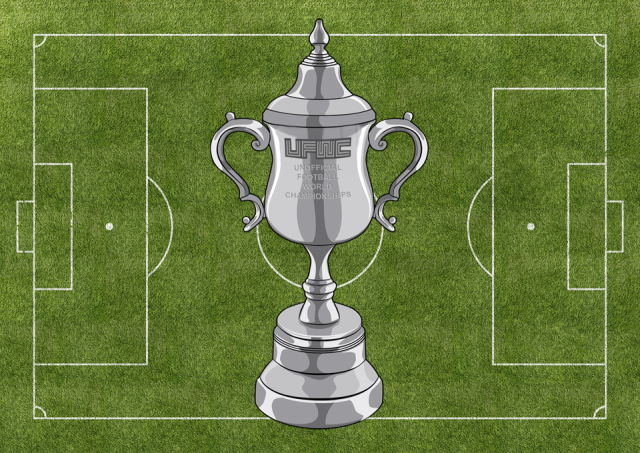
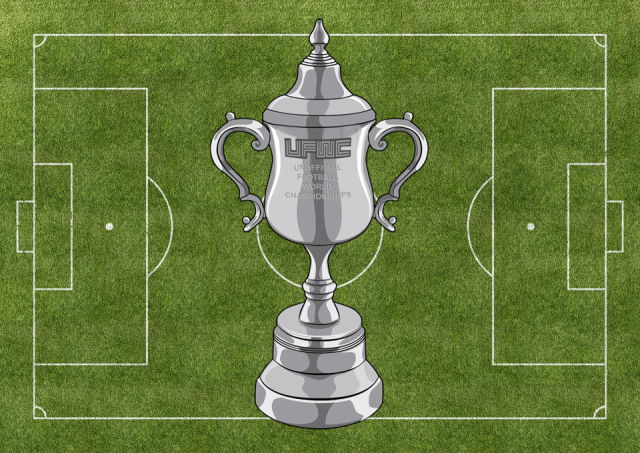
Get your UFWC T-shirts, including Japan mascot and trophy, at our T-shirt shop

UFWC News ,

UFWC spin-offs update: part 1

Features | 11 July 2011 |

Visitors to the Unofficial Football World Championships forum will know that there is plenty of activity away from the main UFWC title, with scores of UFWC spin-off competitions being tracked involving club and national teams. There are a massive 28 spin-offs involving men’s and womens’ national teams. Here, in the first of two posts, Peter Waring reviews the last 12 months in the men’s national UFWC spin-off competitions.

Men’s world wooden sp00n. Macau took the sp00n in April 2009. After their first seven attempts to offload all ended in defeat, they finally beat Cambodia in February 2011. The Cambodians then lost three out of three. Then, on 29 June, Cambodia beat Laos 4-2 and briefly got rid of the unwanted title. Unfortunately for them, Cambodia lost the return fixture 6-2 and regained the wooden sp00n.

Men’s European championship. Greece became European champions with victory over Serbia last August, and have been unbeaten ever since. Amongst their eight successful title defences, the most impressive was a 0-0 draw with Croatia in Zagreb. Their next fixture is on 10th August in Bosnia.

Men’s European wooden sp00n. At the twentieth time of asking, and after a two and a half year tenure, Liechtenstein finally ridded themselves of the sp00n in February with a 1-0 win over fellow microstate San Marino. The Sammarinese have lost two out of two since; it is likely to be a very long time before they get rid of the sp00n – certainly, they won’t offload it in their next fixture, given that they travel to Holland on 2nd September.

Men’s South American championship. Since taking the title in October 2009, Peru have defended it only twice. Matches against Colombia and Ecuador both ended in draws. The title is currently being competed for at the Copa America in Argentina; Peru drew with Uruguay and beat Mexico. Their next match is against Chile on July 12.

Men’s South American wooden sp00n. Rather embarrassingly, Paraguay had been sp00ners since October 2009, despite being World Cup quarter-finalists last year. The problem was that they didn’t play a single South American team again until May 2011. They lost to Argentina (who thus avoided taking the sp00n – they have still not held it since 1909), but then beat Bolivia. Three days later, the sides met again, with a draw ensuring that Bolivia held on to the sp00n. At the Copa America, Bolivia drew with hosts Argentina and lost to Costa Rica and Colombia, being eliminated from the competition and retaining the wooden sp00n.

Men’s African championship. Egypt were champions, following their African Cup of Nations victory in early 2010. Sensationally, they were dispossessed in October by Niger, who then lost the following month (on penalties) to Libya. Despite major political problems, Libya’s football team have retained their unofficial African title through three successful defences. Their next is at home (or more probably on neutral territory) against Mozambique on 2nd September.

Men’s African wooden sp00n. Seychelles are still the holders, having not played since October 2009.

Men’s Asian championship. In October 2010, the Asian title changed hands three times in nine days, from Iran to Kuwait, to Bahrain and eventually to Uzbekistan. The Uzbeks took the title as far as the Asian Cup semi-finals, where they were routed 6-0 by Australia, who themselves lost to Japan in the final. The Asian title, as well as the world title, will be on the line when Japan play South Korea on 10th August.

Men’s Asian wooden sp00n. The Asian sp00n has run in parallel with the world sp00n since 1979, and still does. Cambodia are the holders.

Men’s Concacaf championship. Holders Mexico had not played Concacaf opposition from the end of the 2010 World Cup qualifiers in October 2009 until the Concacaf Gold Cup in June. Mexico defended their title against the United States on June 25th; it was their 100th win in a Concacaf title match. The only country in the world with more continental title match wins is Argentina (144 wins in South America). Next on the list are Brazil (92) and Scotland (85).

Men’s Concacaf wooden sp00n. Anguilla have held the sp00n since 2004, and still do, after four further failures to offload in the last 12 months. At least they managed a draw against the US Virgin Islands – the first time they have done so in over seven years. They were beaten 4-0 by the Dominican Republic in a World Cup qualifier on 8th July.

Men’s Oceanian championship. Holders Fiji have not been in action since 2008. However, they are scheduled to play at the Pacific Games (which double as 2014 World Cup qualifiers) in August 2011.

Men’s Oceanian wooden sp00n. Tonga have not played since 2009, but they too are due at the Pacific Games in August.

Tomorrow in part 2, Peter covers the women’s UFWC titles – and clears up recent confusion over the main WUFWC title. (We’re blaming the FA!).

Features , , , , , , , , , ,

Austria vs Greece 1967

Classic Matches | 25 February 2011 |

CLASSIC UFWC TITLE MATCH:

Austria 1-1 Greece
(Match abandoned but score stands)
5 November 1967
European Championships Qualifier, Praterstadion, Vienna
Scorers: Siber (Austria); Sideris (Greece)

On paper this match should not have offered much to get excited about. The last Group 3 qualifying match for the 1968 European Championships was effectively meaningless, as the USSR had already secured the only qualifying spot at the top of the table. To the uninformed observer, Austria and Greece were playing for nothing but pride, and certainly the match was very ordinary for the first 84 minutes. But, unbeknown to those involved, there was something important at stake – the not-inconsequential matter of the UFWC title.

Helmut Siber of German club Kickers Offenbach struck after 32 minutes to give title-holders Austria a first half lead. Free-scoring Olympiakos striker Giorgios Sideris pulled Greece level in the 73rd minute, but the match only really came to life amid late controversy. In the 85th minute on the 5th of November, fireworks duly erupted, ensuring the match would go down in history as one of the strangest ever played.

With just five minutes left to play, referee Gyula Gere of Hungary saw fit to send off Greece’s star player, Takis Loukanidis. For the record, Panathinaikos’s footballing all-rounder Loukanidis is now considered one of Greece’s best ever players and was regarded at the time as something approaching a living Greek god. Inevitably, the Greek supporters in the crowd were enraged, and mindless mayhem immediately erupted.

Scores of spectators, apparently of both Greek and Austrian persuasion, charged onto the pitch and began to engage in a mass brawl. Players from both sides were caught up and became involved in furious fistfights, while ref Gere was unceremoniously bashed over the head with a bottle.

A full-scale riot was underway, and 200 Austrian policemen, with horses, dogs, and big sticks, were sent onto the pitch to put an end to it. Order was eventually restored but there was no sensible way that play could continue, so the match was abandoned.

In the aftermath of the riot the Austrian authorities were severely reprimanded, and UEFA threatened to make Austria play all fixtures away from home if such an incident ever happened again. But what made the case particularly unusual was UEFA’s decision not to order a replay. UEFA declared that the 1-1 score should stand, even though the match had not been completed. The fact that the result had no effect on European Championships qualification probably had some bearing on the decision. As, no doubt, did the possibility of another riot.

This was only the second UFWC title match in history to be abandoned (the other being the Ibrox disaster of 1902), but the score in this one stands for UFWC purposes, as it does for official FIFA records.

Not that the 1-1 draw changed the title-holders or ranking points, with Austria retaining the title for another seven months before losing 3-1 to the Soviet Union.

This is an edited extract from the Unofficial Football World Champions book, which tells the story of the UFWC via more than 100 classic title matches. Get more details here.

Classic Matches ,